
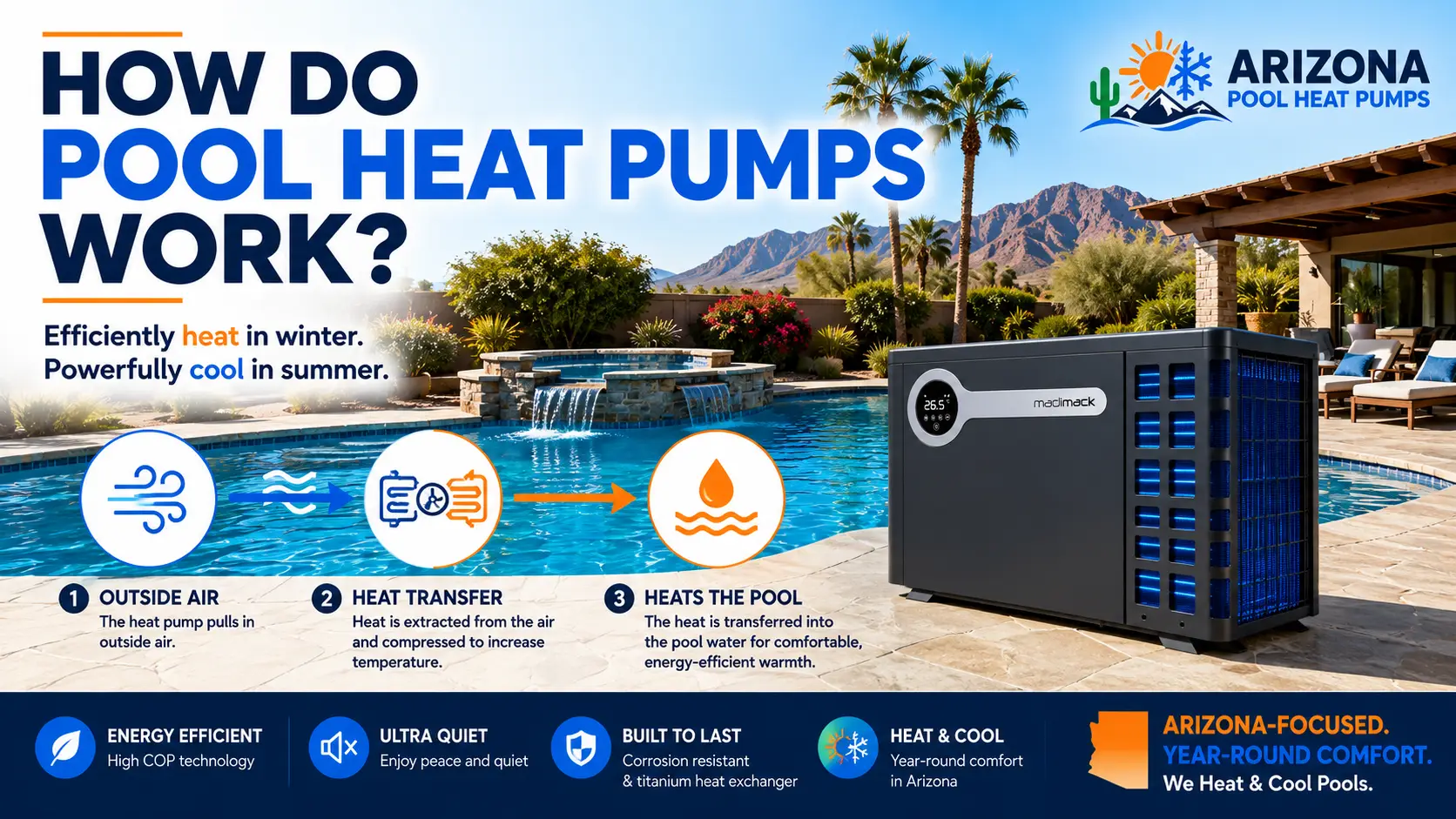
Pool heat pumps can help Arizona pool owners maintain more comfortable water temperatures throughout the year. Spring mornings can leave the water surprisingly cool, winter temperatures can make swimming uncomfortable, and during the hottest part of summer, pool water can become warmer than many swimmers prefer.
A pool heat pump offers a highly efficient way to manage pool temperature by transferring heat rather than creating it through combustion. And with a heat-and-cool pool heat pump, the same system can also remove heat from the water when your pool becomes too warm.
Understanding how this technology works can help you decide whether a pool heat pump is the right choice for extending your swimming season or maintaining more comfortable water temperatures throughout the year.
What Is a Pool Heat Pump?
A pool heat pump is an electrically powered system designed to transfer heat between the surrounding air and your swimming pool water.
Unlike a traditional gas pool heater, which burns natural gas or propane to generate heat, a heat pump captures thermal energy that already exists in the outside air and transfers that energy into the pool.
This difference is important. The electricity used by the heat pump primarily operates the compressor, fan, controls, and other components that move heat through the system.
When equipped with both heating and cooling capabilities, the refrigeration cycle can be reversed so the system can also remove excess heat from the pool water.
That makes heat-and-cool technology especially useful in Arizona, where homeowners may want warmer pool water during cooler months and cooler water during periods of extreme summer heat.
How a Pool Heat Pump Heats Your Pool
Your pool’s circulation system continually moves water through the pool equipment. When a heat pump is operating, pool water passes through the heat pump where heat is transferred into the water before it returns to the pool.
The process generally works like this:
1. The fan draws outside air into the heat pump.
Even when the air doesn’t feel particularly warm, it can still contain usable thermal energy.
2. The evaporator absorbs heat from the air.
Refrigerant circulating through the evaporator absorbs heat from the surrounding air.
3. The compressor increases the refrigerant temperature.
The compressor pressurizes the refrigerant, substantially increasing its temperature.
4. Heat is transferred into the pool water.
The heated refrigerant moves through the heat exchanger. Pool water flowing through the heat exchanger absorbs that heat.
5. Heated water returns to the swimming pool.
The pool’s circulation system carries the warmer water back to the pool, and the process continues until the desired temperature is reached.
The refrigerant then continues through the refrigeration cycle and repeats the process.
How Does a Pool Heat Pump Cool the Water?
For Arizona pool owners, cooling can be nearly as important as heating.
During prolonged periods of extreme summer heat, swimming pools—particularly those receiving substantial direct sunlight—can reach temperatures that are no longer refreshing.
A heat-and-cool pool heat pump can reverse the refrigeration process.
Instead of transferring heat from the outside air into the pool, the system removes heat from the pool water and transfers it to the surrounding air.
This allows one piece of equipment to serve two purposes:
- Heat the pool during cooler weather
- Cool the pool during hot Arizona summers
The result is greater control over pool-water temperature across a much longer portion of the year.
Pool Heat Pump vs. Gas Pool Heater
Both systems can heat swimming pools, but they accomplish the job very differently.
A gas heater produces heat by burning natural gas or propane. This allows gas heaters to deliver substantial heating output quickly, which can make them useful when rapid temperature increases are required.
A pool heat pump takes a different approach. It extracts heat from the surrounding air and transfers it into the pool water.
Because heat pumps transfer existing heat rather than producing all of their heat through fuel combustion, they can provide excellent energy efficiency under appropriate operating conditions.
The better choice depends on several factors, including:
- Pool size
- Desired water temperature
- Swimming season
- How frequently the pool will be heated
- Local weather conditions
- Electricity rates
- Natural gas or propane costs
- Pool-cover use
- Whether summer cooling is desired
For this reason, comparing pool heaters based only on equipment size or purchase price doesn’t provide the complete picture.
Why Air Temperature Matters
Pool heat pump performance is affected by outdoor conditions.
Because the system obtains heat from the surrounding air, warmer air generally provides more available heat for the system to transfer into the pool.
As outdoor temperatures fall, there is less available heat in the air, and heating performance can change.
This is one reason proper heat pump sizing is important. A system should be evaluated based on the conditions under which the homeowner actually expects to use the pool—not simply the pool’s gallon capacity.
For Arizona installations, we also consider seasonal temperatures, desired swimming months, pool exposure, wind, shade, and other factors when evaluating equipment requirements.
Why Pool Size Isn’t the Only Sizing Factor
One of the most common misconceptions about pool heat pumps is that they can be properly sized using pool gallons alone.
Pool volume certainly matters, but it’s only part of the equation.
The surface area of the pool is particularly important because significant heat loss occurs where the water is exposed to the surrounding air.
Other important factors include:
- Desired water temperature
- Outdoor air temperature
- Pool surface area and volume
- Sun and shade exposure
- Wind exposure
- Evaporation
- Swimming season
- Pool-cover use
- Attached spas
- Heating and cooling expectations
Two pools containing approximately the same number of gallons can therefore have very different heating requirements.
Why Pool Covers Can Make Such a Difference
Evaporation is a major source of swimming-pool heat loss.
As heated water evaporates from the surface, energy leaves the pool with it. Wind can accelerate this process, which is why exposed pools may lose heat more rapidly than pools protected by walls, landscaping, or other structures.
A properly used pool cover can reduce evaporation and help retain heat when the pool isn’t being used.
For homeowners planning to heat their pools extensively during cooler periods, pool-cover use can have a significant effect on overall system performance and energy consumption.
Do Pool Heat Pumps Heat Water Instantly?
No—and this is an important distinction between heat pumps and traditional gas heaters.
Pool heat pumps are generally designed to gradually raise and maintain water temperature, rather than provide the rapid temperature increase commonly associated with high-output gas heaters.
How long a pool takes to reach its desired temperature depends on the pool, equipment, weather, starting water temperature, heat loss, and other conditions.
Once the desired temperature is reached, the heat pump cycles as necessary to help maintain it.
This operating approach makes proper system sizing and realistic expectations particularly important.
What Makes Inverter Pool Heat Pumps Different?
Traditional pool heat pumps may operate at a fixed output whenever heating is required.
Modern inverter-driven pool heat pumps can vary compressor and fan operation according to the heating or cooling demand.
Instead of always operating at maximum output and then shutting off, an inverter system can reduce its operating speed as the pool approaches the desired temperature.
Depending on operating conditions, this can provide several benefits, including quieter operation, improved temperature control, and efficient operation when full capacity isn’t required.
The Arizona Pool Heat Pumps systems we focus on use modern inverter technology for both pool heating and cooling.
Can a Heat Pump Maintain Comfortable Pool Water Year-Round in Arizona?
Potentially, but this needs to be evaluated for the individual pool.
Arizona provides favorable conditions for pool heat pumps during much of the year, but Arizona also has substantial differences in climate depending on location, elevation, season, nighttime temperatures, and weather.
Even within the Phoenix area, pool conditions can vary considerably because of sun exposure, shade, wind, pool design, and homeowner expectations.
That’s why we don’t recommend choosing a heat pump solely from an online chart based on gallons.
The better approach is to determine when you want to swim, what water temperature you want, and what conditions your particular pool experiences.
Is a Pool Heat Pump Right for Your Arizona Pool?
A pool heat pump can be an excellent solution for Arizona homeowners who want to extend their swimming season, maintain more consistent water temperatures, or add the ability to cool an excessively warm pool during summer.
But the right equipment depends on the pool and how you intend to use it.
Before selecting a system, consider:
- How many months of the year you want to swim
- Your preferred water temperature
- Whether you need heating, cooling, or both
- Your pool’s dimensions and surface area
- Sun and shade conditions
- Wind exposure
- Whether you use a pool cover
- Your electricity rate
- Your current pool-heating system
A properly evaluated and sized system will give you a much better understanding of what you can reasonably expect from your pool heat pump.
Get a FREE Pool Heating & Cooling Analysis
Not sure what size pool heat pump your Arizona pool needs?
Our FREE Pool Heating & Cooling Analysis evaluates your pool size, swimming season, desired water temperature, sun and shade exposure, wind conditions, pool-cover use, energy costs, and heating and cooling goals.
We’ll use that information to help determine the appropriate heat pump solution for your pool and provide a personalized heating and cooling cost analysis.
Get My FREE Pool Heating & Cooling Analysis