
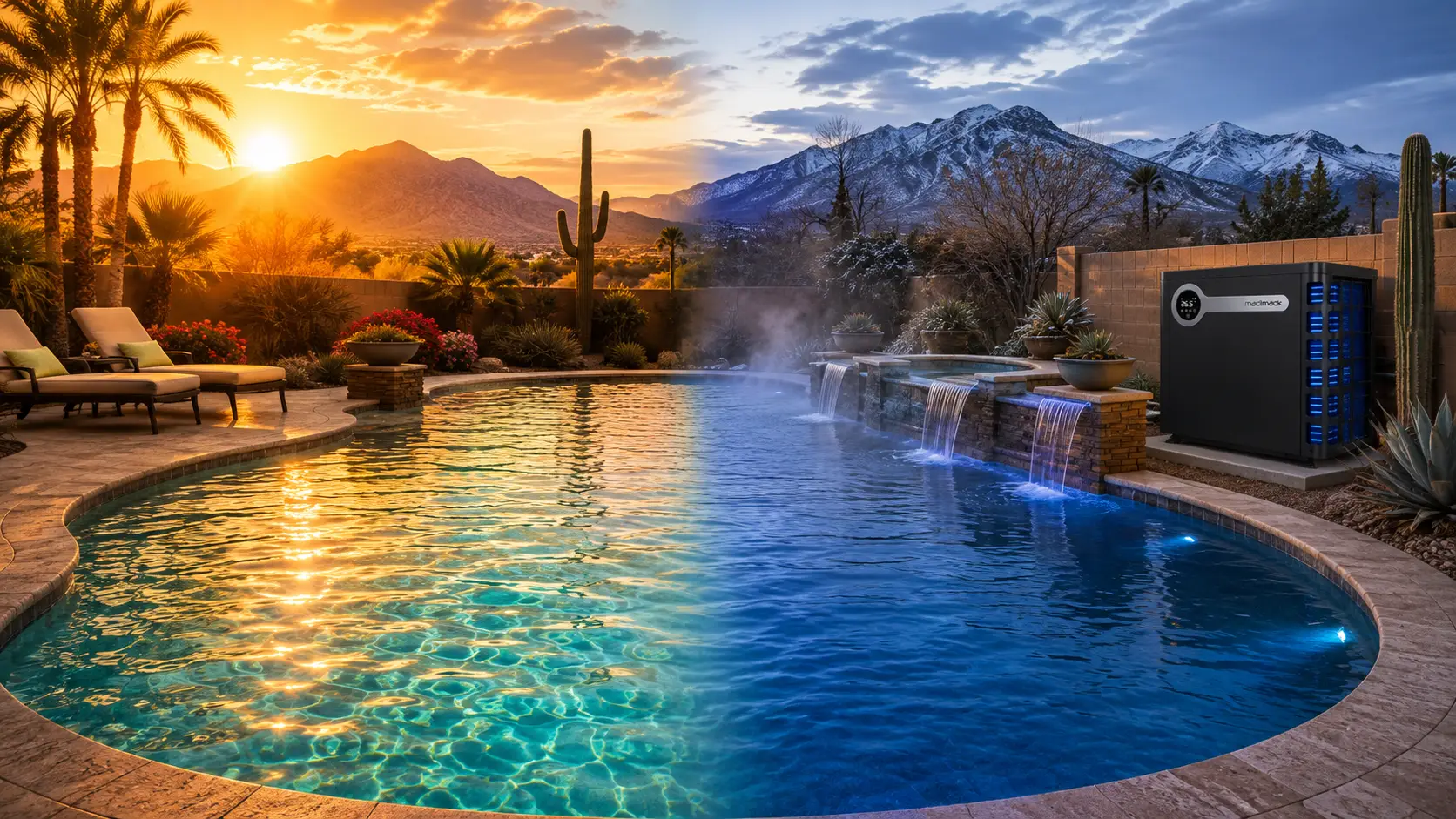
Owning a swimming pool in Arizona comes with an unusual challenge. During the cooler months, your pool water can become too cold to enjoy even when the afternoon weather feels beautiful. Then, during the hottest part of summer, the opposite can happen—the water becomes so warm that your pool no longer provides the refreshing escape you expected.
For homeowners in Phoenix, Chandler, Mesa, Gilbert, Scottsdale, and surrounding Arizona communities, keeping a pool comfortable year-round requires more than simply watching the outdoor temperature.
Sun exposure, nighttime temperatures, evaporation, wind, pool size, landscaping, pool covers, and your heating and cooling equipment can all affect water temperature.
The good news is that Arizona’s climate also provides opportunities to extend your swimming season significantly. Understanding how your pool gains and loses heat can help you make better decisions about when to heat, when to cool, and how to maintain a more comfortable swimming environment.
Here are some practical Arizona pool tips to help you get more enjoyment from your swimming pool throughout the year.
What Is a Comfortable Swimming Pool Temperature?
There isn’t one perfect pool temperature for everyone.
Some swimmers are comfortable in water around 78°F to 80°F, while families, recreational swimmers, and people who simply prefer warmer water may enjoy temperatures in the low to mid-80s.
The important thing is finding the temperature that works for your family and the way you use your pool.
During Arizona’s shoulder seasons, maintaining a few additional degrees of water temperature can make the difference between using your pool and simply looking at it.
Summer presents the opposite challenge. After weeks of intense Arizona sunshine and high nighttime temperatures, pool water can become warmer than many swimmers find refreshing.
That’s why year-round pool comfort in Arizona can involve both heating and cooling.
Arizona’s Climate Creates Two Different Pool Seasons
Arizona pool owners experience conditions that are very different from many other parts of the country.
Instead of thinking only about a traditional summer swimming season, it helps to think about two different temperature-management challenges.
Cooler Months: Preventing Heat Loss
During spring, fall, and winter, daytime temperatures can be pleasant while nighttime temperatures drop considerably.
Your pool may absorb heat during the day and then lose much of it overnight.
That means a beautiful 75°F Arizona afternoon doesn’t necessarily translate into comfortable pool water.
Maintaining comfortable water during these periods requires managing heat loss as well as adding heat when necessary.
Hotter Months: Managing Excess Pool Heat
During the hottest part of the Arizona summer, pools can experience the opposite problem.
Long hours of direct sunlight combined with very warm nighttime temperatures can gradually raise the water temperature.
When that happens, swimming may become less refreshing.
A heat-and-cool pool heat pump can provide both sides of the equation—adding heat during cooler weather and removing heat when summer pool temperatures become uncomfortable.
Tip #1: Pay Attention to Nighttime Temperatures
One of the most overlooked Arizona pool tips is to pay attention to overnight temperatures, not just the daytime high.
Swimming pools contain a large volume of water. Water temperature changes more slowly than air temperature, which means one warm afternoon won’t necessarily warm a cold pool enough for comfortable swimming.
Likewise, repeated cool nights can remove a substantial amount of accumulated heat.
This is particularly important during spring and fall when Arizona can experience warm afternoons followed by much cooler evenings.
If you’re trying to extend your swimming season, nighttime temperatures are an important part of determining how much heating your pool may require.
Tip #2: Control Evaporation Whenever Possible
Evaporation is one of the major ways swimming pools lose heat.
Arizona’s dry climate can make evaporation particularly noticeable. Wind moving across the surface of the pool can accelerate that process even further.
When water evaporates, heat leaves with it.
This means your pool isn’t simply losing water—it can also be losing energy you’ve paid to put into it.
Consider Using a Pool Cover
A pool cover can help reduce evaporation and retain heat, particularly overnight.
For homeowners who regularly heat their pools, reducing overnight heat loss can improve overall system efficiency and help the pool maintain its target temperature.
A cover can be especially useful during cooler Arizona months when daytime conditions are pleasant but nighttime temperatures drop.
Pool covers aren’t practical for every homeowner or every pool design, but they are worth considering if extending your swimming season is a priority.
Tip #3: Understand How Sun and Shade Affect Your Pool
Two swimming pools located only a few streets apart can behave very differently.
A pool receiving direct Arizona sunshine for most of the day may naturally gain considerably more heat than a pool shaded by:
- The home
- Mature trees
- Patio structures
- Walls
- Neighboring buildings
- Landscape features
This is why pool size alone isn’t enough to determine heating and cooling requirements.
A heavily shaded pool in Scottsdale may require a different heating strategy than a similar-sized pool in Mesa receiving full afternoon sun.
The same principle applies during summer. A pool exposed to intense sunlight throughout the day may experience greater unwanted heat gain.
When evaluating pool comfort, always consider the environment surrounding the pool.
Tip #4: Don’t Ignore Wind Exposure
Wind can have a surprisingly large effect on pool temperature.
A pool in an open area with consistent airflow may lose heat faster than a pool protected by the house, landscaping, or walls.
Wind can also increase evaporation, which contributes to additional heat loss.
This is particularly important when sizing a pool heating system.
Two pools with identical dimensions and water volume can have different heating requirements simply because one is more exposed to wind.
That’s why a proper pool heat pump evaluation should consider pool dimensions, sun exposure, shade, wind, desired temperature, swimming season, and pool-cover use rather than relying on gallons alone.
Tip #5: Extend Your Swimming Season Instead of Heating Only on Demand
Many Arizona homeowners don’t necessarily need to maintain summer-like water temperatures every day of the year.
Instead, their goal may be to extend the usable swimming season.
For example, heating may allow a homeowner to begin swimming earlier in spring and continue later into fall.
This can be an efficient way to get considerably more use from a backyard pool without necessarily trying to maintain the same water temperature through every winter condition.
Think about when your family actually wants to swim.
Your desired swimming months are one of the most important factors when evaluating an appropriate pool heating solution.
Tip #6: Don’t Let Your Arizona Pool Get Too Warm in Summer
Pool heating gets plenty of attention, but pool cooling is equally relevant in Arizona.
During extended periods of extreme heat, swimming pool temperatures can climb above the level many homeowners find refreshing.
This is especially common in pools that receive substantial direct sunlight.
A pool that feels refreshing at 82°F can provide a very different experience when the water becomes significantly warmer.
Heat-and-Cool Pool Heat Pumps
Some modern inverter pool heat pumps are capable of operating in both directions.
During cooler weather, the system transfers heat from the surrounding air into the pool water.
During cooling operation, the process is reversed so heat can be removed from the pool water.
For Arizona homeowners interested in maintaining a more consistent swimming temperature across multiple seasons, heating and cooling from one system can be particularly valuable.
Tip #7: Choose Your Desired Water Temperature Carefully
Every additional degree matters when heating a large body of water.
Before selecting equipment or estimating operating costs, determine the temperature you actually want.
Instead of saying:
“I want the pool warm.”
Think in terms of a realistic target such as:
“We’d like to maintain approximately 82°F when we’re using the pool.”
A defined target temperature makes it much easier to evaluate system sizing, heating performance, and potential operating requirements.
The difference between maintaining 80°F and maintaining 86°F can become significant during cooler weather.
Your target water temperature should therefore be part of any professional pool heat pump evaluation.
Tip #8: Use Variable-Speed Pool Equipment Wisely
A pool heat pump operates as part of your overall pool circulation system.
Water must circulate through the heat pump for heating or cooling to occur.
Many Arizona pools now use variable-speed pumps, which can provide flexibility in how the circulation system operates.
Proper flow is important for heat pump performance, so circulation schedules and pump speeds should be configured with the heating and cooling equipment in mind.
The goal isn’t simply to run equipment longer or faster. It’s to establish appropriate water flow while operating the system efficiently.
A qualified installer should evaluate the existing pool equipment and plumbing when planning a heat pump installation.
Tip #9: Size the Heat Pump for the Pool—and Your Goals
One of the biggest mistakes homeowners can make is selecting a pool heat pump based only on price or a simple gallons chart.
Proper sizing involves more than water volume.
Factors can include:
- Pool surface area
- Pool volume
- Desired water temperature
- Months you plan to swim
- Sun exposure
- Shade
- Wind exposure
- Pool-cover use
- Local climate
- Heating expectations
- Cooling requirements
- Attached spa configuration
- Existing pool equipment
A homeowner in Chandler who wants comfortable water from early spring through late fall may need a different solution than a homeowner in Gilbert who primarily wants to cool the pool during the hottest summer months.
The equipment should fit the objective—not the other way around.
Tip #10: Take Advantage of Inverter Technology
Traditional pool heating equipment often operates at a fixed output.
Modern full-inverter pool heat pumps can adjust operation based on heating or cooling demand.
Rather than operating at maximum output every time the system runs, inverter technology allows the unit to modulate its performance as conditions change.
This can provide quieter operation and more precise temperature management while allowing the system to operate efficiently under varying conditions.
For Arizona pool owners interested in maintaining consistent temperatures across changing seasons, variable operation can be particularly useful.
Pool Comfort in Phoenix, Chandler, Mesa, Gilbert and Scottsdale
Arizona isn’t one uniform environment.
Even within the Phoenix metropolitan area, individual pools can experience very different conditions.
A Phoenix pool surrounded by block walls and full afternoon sun may retain and gain heat differently from a heavily landscaped Scottsdale backyard.
Pools in Mesa and Gilbert may have large open yards with greater sun or wind exposure, while properties in Chandler can have their own combinations of shade, structures, landscaping, and pool orientation.
That’s why generalized recommendations only go so far.
Your backyard creates its own small environment.
When evaluating heating and cooling, what matters most is how your particular pool responds to Arizona’s climate.
Should You Heat, Cool, or Do Both?
For many Arizona homeowners, the answer depends on how they want to use the pool.
Heating May Be the Priority If:
You want to start swimming earlier in spring, continue later into fall, maintain warmer water during cooler periods, or simply get more months of enjoyment from the pool.
Cooling May Be the Priority If:
Your pool becomes excessively warm during summer and you want the water to remain more refreshing during periods of extreme Arizona heat.
Heating and Cooling May Make Sense If:
You want greater control over pool temperature across multiple seasons rather than solving only one side of the problem.
This is where a reversible heat-and-cool pool heat pump can be particularly well suited to Arizona.
How Can You Keep Pool Heating and Cooling Costs Under Control?
There is no single operating-cost number that applies to every Arizona pool.
Energy usage depends on the pool, weather, equipment, temperature settings, swimming season, and how the system is operated.
However, homeowners can make smarter decisions by focusing on a few fundamentals.
Reduce Unnecessary Heat Loss
Limit evaporation when practical, consider pool-cover use, and understand how wind affects your pool.
Set a Realistic Target Temperature
Avoid heating the water substantially warmer than necessary for your family’s comfort.
Match Equipment to the Pool
Proper sizing helps ensure the system is appropriate for the pool and the homeowner’s expectations.
Consider Your Actual Swimming Season
Determine when you realistically plan to use the pool rather than assuming it must maintain the same temperature every day of the year.
Evaluate Your Pool Individually
Operating costs should be estimated using your actual pool conditions and local energy costs rather than generic national averages.
Make Your Arizona Pool Work for More of the Year
A swimming pool is a major part of the Arizona backyard lifestyle, but Arizona weather doesn’t automatically guarantee comfortable water every month.
Cool nights can shorten the swimming season. Intense summer heat can make pool water warmer than desired. Evaporation, wind, shade, sun exposure, and equipment operation all influence the result.
Understanding these factors allows you to manage your pool more effectively.
For homeowners in Phoenix, Chandler, Mesa, Gilbert, Scottsdale, and throughout the Valley, modern pool heating and cooling technology can provide greater control over water temperature and help make the pool enjoyable through more of the year.
The key is not simply installing the biggest heater available. It’s understanding your pool, your property, your preferred water temperature, and when you actually want to swim.
Find the Right Heating & Cooling Strategy for Your Arizona Pool
Every Arizona pool is different.
At Arizona Pool Heat Pumps, we evaluate the factors that affect your specific pool—including size, swimming season, desired temperature, sun and shade exposure, wind conditions, pool-cover use, existing equipment, and your heating and cooling goals.
That allows us to recommend a pool heat pump solution based on how you actually want to use your pool.
If you’d like to find out what makes sense for your backyard, request a FREE Pool Heat Pump Evaluation and we’ll help you determine the right heating and cooling approach for your Arizona pool.
Get a FREE Pool Heat Pump Evaluation