
Commercial Pool Heating & Cooling Solutions for Arizona
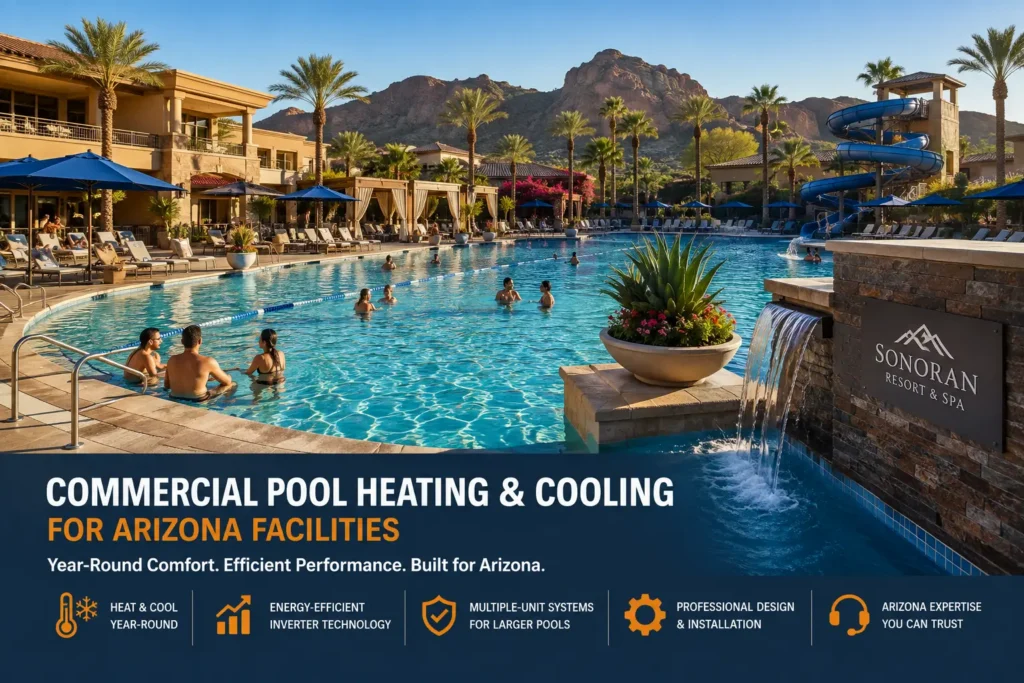
Commercial Pool Heat Pumps are designed for facilities with very different heating and cooling requirements than residential pools. Larger water volumes, longer operating hours, higher swimmer loads, and year-round temperature demands require equipment that is properly sized for the application.
Arizona’s climate creates an additional challenge. Commercial pools may need dependable heating during cooler months while requiring active cooling during extreme summer temperatures. A properly designed commercial pool heat pump system can help maintain a more consistent and comfortable water temperature throughout the year.
Arizona Pool Heat Pumps provides commercial heat pump solutions designed around the specific requirements of each facility, including pool size, desired water temperature, operating schedule, existing equipment, electrical capacity, plumbing configuration, and available installation space.
Commercial pool heat pumps can provide efficient heating and cooling for facilities that need dependable water-temperature control across longer operating seasons. The right system depends on the size of the pool, usage patterns, desired temperature, operating hours, and the facility’s existing mechanical and electrical systems.
Commercial Pool Heat Pumps for Arizona Facilities
Commercial Applications We Serve
- Hotels & Resorts — Maintain comfortable pool and spa temperatures for guests throughout the year.
- HOAs & Community Pools — Extend the swimming season while providing more consistent water temperatures for residents.
- Apartment & Multifamily Communities — Improve pool comfort and help increase the usability of community amenities.
- Fitness & Aquatic Centers — Support pools with longer operating hours and demanding temperature requirements.
- Schools & Swim Programs — Provide dependable temperature control for training, lessons, and competitive swimming.
- Therapy & Rehabilitation Pools — Help maintain the consistent warmer water temperatures required by many therapy applications.
- Municipal & Public Pools — Provide an energy-efficient heating and cooling option for larger recreational facilities.
Because commercial facilities can have significantly different operating requirements, equipment selection should be based on the actual heating and cooling load rather than pool volume alone.
How Commercial Pool Heat Pumps Are Sized
Commercial pool heat pump sizing requires more than knowing the number of gallons in the pool. A commercial system must be designed around the amount of heat the pool loses, the desired water temperature, operating schedule, seasonal conditions, and how quickly the facility expects the pool to recover temperature.
Large commercial pools can require substantially more heating and cooling capacity than a single residential-style heat pump can provide. Depending on the application, multiple heat pumps may be installed together to provide the required capacity.
Proper sizing is especially important in Arizona because the same pool may face cool nighttime temperatures during winter and extreme daytime heat during summer.
- Pool Surface Area & Water Volume — Larger pools generally require greater heating and cooling capacity.
- Desired Water Temperature — The greater the temperature difference between the pool and surrounding air, the greater the heating demand.
- Operating Season — Year-round facilities have different requirements than pools operated only during spring, summer, and fall.
- Pool Usage & Operating Hours — Hotels, fitness centers, HOAs, and public facilities may operate for extended hours each day.
- Evaporation & Wind Exposure — Evaporation is a major source of pool heat loss, particularly for exposed outdoor commercial pools.
- Pool Covers — Properly used covers can significantly reduce evaporation and heat loss.
- Heating Recovery Time — Facilities that require faster temperature recovery may need additional capacity.
- Available Electrical Service — Electrical capacity must be evaluated when designing larger commercial heat pump systems.
Factors We Consider When Sizing a Commercial System
The objective is not simply to install the largest equipment available. The goal is to design a system with the right capacity for the facility’s actual operating requirements.
Multiple Heat Pump Systems for Larger Commercial Pools
Larger commercial pools may require more heating and cooling capacity than a single heat pump can provide. In these applications, multiple heat pumps can be installed together to create a commercial system capable of meeting the facility’s total heating and cooling demand.
Using multiple units also allows the system capacity to better match changing conditions. During periods of lower demand, fewer heat pumps may be needed. As heating or cooling demand increases, additional units can operate to provide greater capacity.
This approach can be particularly useful for Arizona commercial pools where operating conditions can change dramatically between cooler winter nights and extreme summer temperatures.
Advantages of a Multiple-Unit Commercial System
- Greater Total Capacity — Multiple heat pumps can provide the output required for larger pools and demanding applications.
- Flexible System Design — Equipment can be configured around the facility’s available space, plumbing, and electrical infrastructure.
- Staged Operation — System capacity can better respond to changing heating and cooling requirements.
- Improved System Redundancy — With multiple units, the facility may retain partial heating or cooling capability if one unit is temporarily unavailable for service.
- Efficient Part-Load Operation — The system does not necessarily need every heat pump operating when demand is lower.
- Future Expansion — Depending on the original system design, additional capacity may be easier to accommodate as facility requirements change.
The number and size of heat pumps required should be determined through a proper commercial evaluation rather than simply duplicating a residential installation.
Commercial Pool Heating & Cooling in Arizona
Arizona presents unique challenges for commercial swimming pools because water-temperature requirements can change significantly throughout the year. Cooler nights and winter weather can create substantial heating demand, while intense summer heat can push pool temperatures beyond comfortable levels.
A properly designed heat-and-cool system gives commercial facilities the ability to address both conditions. During cooler weather, the system transfers heat from the surrounding air into the pool. During hot weather, the process can be reversed to remove excess heat from the pool water.
For hotels, resorts, HOAs, fitness centers, and other facilities, this ability to both heat and cool can help provide more consistent water temperatures and extend the usable swimming season.
Why Heating and Cooling Matters for Arizona Commercial Pools
- Year-Round Temperature Control — Manage pool temperatures through both cooler winter conditions and extreme summer heat.
- Improved Guest & Resident Comfort — More consistent water temperatures can improve the swimming experience.
- Extended Swimming Season — Heating allows facilities to keep pools comfortable beyond Arizona’s naturally warm months.
- Summer Pool Cooling — Active cooling can help when prolonged heat and direct sunlight cause pool temperatures to climb.
- Better Temperature Management — Commercial operators have greater control instead of relying entirely on changing outdoor conditions.
- One System for Heating & Cooling — A heat-and-cool system can perform both functions without separate pool heating and cooling equipment.
or Arizona commercial facilities, the objective is not simply to make the pool warmer. It is to provide better control over pool-water temperature throughout the year.
Energy-Efficient Commercial Pool Heating
Commercial swimming pools can require many hours of heating or cooling throughout the year, making energy efficiency an important consideration when selecting equipment. Unlike gas heaters that create heat by burning fuel, a pool heat pump primarily uses electricity to transfer existing heat between the surrounding air and the pool water.
For facilities with long operating schedules, properly sized heat pump systems can provide an efficient way to maintain desired pool temperatures rather than relying on rapid heating only when the pool is needed.
Inverter technology can provide an additional advantage by allowing heat pump output to adjust as conditions and temperature demand change instead of operating only at full capacity.
Why Inverter Technology Matters for Commercial Pools
- Variable-Speed Operation — Inverter technology can adjust compressor output based on current heating or cooling demand.
- Efficient Temperature Maintenance — Once the desired water temperature is reached, the system can reduce output rather than repeatedly operating at maximum capacity.
- Better Part-Load Performance — Commercial pools frequently require temperature maintenance rather than full heating capacity at all times.
- Heating & Cooling Capability — Heat-and-cool systems provide commercial facilities with greater year-round temperature control.
- Reduced Cycling — Modulating operation can reduce unnecessary full-capacity starts and stops as temperature demand changes.
- System Flexibility — Multiple inverter heat pumps can be configured to provide capacity appropriate for larger commercial applications.
Actual energy use will vary considerably between commercial facilities. Pool size, water temperature, ambient conditions, operating hours, wind exposure, evaporation, pool covers, and equipment sizing can all affect system performance and operating costs.
Madimack InverTITAN Heat Pumps for Commercial Pools
Arizona Pool Heat Pumps uses Madimack InverTITAN heat-and-cool technology for commercial applications where efficient operation, variable capacity, and year-round temperature control are important.
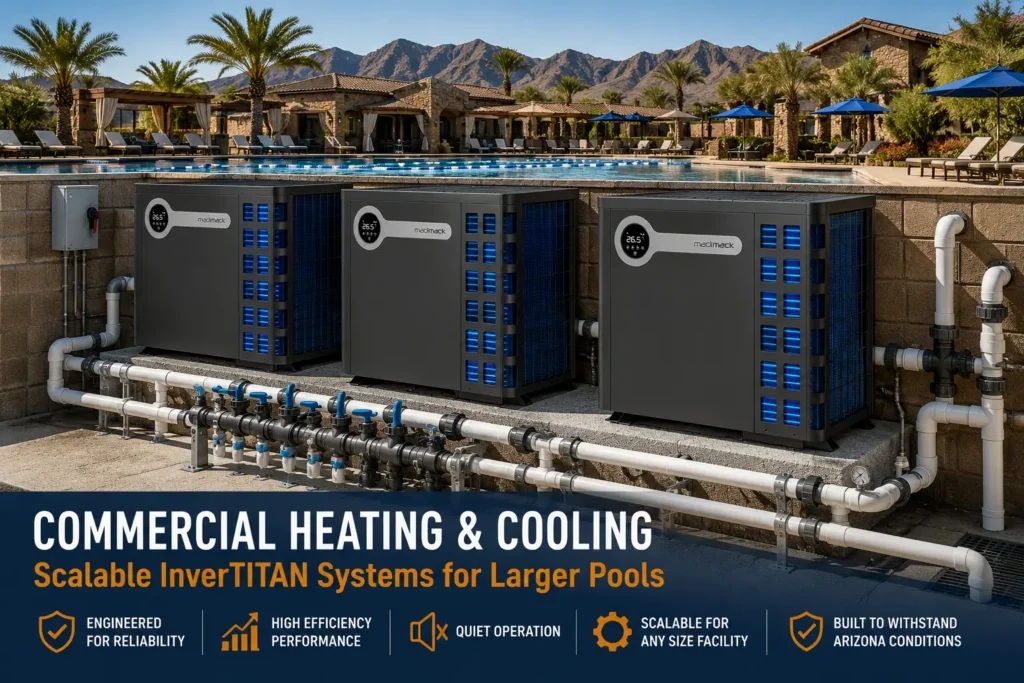
For larger pools, multiple InverTITAN heat pumps can be incorporated into the system design to provide the combined capacity required for the facility. This allows the equipment configuration to be matched more closely to the pool’s calculated heating and cooling requirements.
Because every commercial facility is different, the appropriate equipment configuration should be determined after evaluating the pool, operating requirements, existing circulation equipment, electrical service, plumbing, and installation area.
Commercial System Design Considerations
- Required Heating & Cooling Capacity — Equipment should be selected according to the calculated demands of the pool.
- Number of Heat Pumps — Larger applications may require multiple InverTITAN units working as part of one system.
- Plumbing & Water Flow — The circulation system must provide appropriate flow through the heat-pump installation.
- Electrical Requirements — Available electrical service and the requirements of the proposed equipment must be evaluated.
- Equipment Placement & Airflow — Heat pumps require sufficient surrounding space and airflow for proper operation.
- Existing Pool Equipment — Pumps, filters, sanitizing systems, automation, and other equipment need to be considered during system design.
- Service Accessibility — Equipment should be positioned so routine maintenance and future service can be performed properly.
Our goal is to design the commercial system around the facility and its actual operating requirements, rather than using a one-size-fits-all equipment recommendation.
Commercial Pool Heat Pump Installation Requirements
Commercial heat pump installations require careful planning because larger systems may involve multiple heat pumps, higher water-flow requirements, additional electrical capacity, and more complex plumbing than a typical residential installation.
Before equipment is installed, the existing pool circulation system, equipment area, electrical service, plumbing configuration, and available airflow should be evaluated. When multiple heat pumps are used, the system must also be configured so water flow is properly distributed through the equipment.
Proper installation helps ensure the commercial heat pump system can deliver the heating and cooling capacity it was designed to provide.
What We Evaluate Before Installation
- Equipment Location — Confirm adequate space, airflow, clearances, drainage, and service access.
- Pool Circulation System — Evaluate pumps, filters, plumbing size, and available water flow.
- Plumbing Configuration — Determine how the heat pumps will integrate with the existing circulation system.
- Electrical Capacity — Evaluate available electrical service and the requirements of the proposed equipment.
- Multiple-Unit Configuration — Plan plumbing and equipment placement when two or more heat pumps are required.
- Existing Automation & Controls — Consider how the new system will operate with existing pool controls and equipment.
- Equipment Access — Make sure the installation area allows appropriate access for future inspection, maintenance, and service.
Commercial installations should be evaluated individually because existing equipment and site conditions can vary significantly from one property to another. Proper planning before installation helps identify these requirements before equipment is selected and installed.
Why Arizona Facilities Choose Commercial Pool Heat Pumps
For commercial pool operators, maintaining comfortable water temperatures can directly affect how often the pool is used and how guests, residents, members, and swimmers experience the facility. Arizona’s climate makes dependable temperature control especially valuable because pool conditions can vary dramatically throughout the year.
A properly designed commercial heat pump system provides both heating and cooling capability, giving facility operators greater control over pool-water temperature without relying entirely on seasonal weather conditions.
Benefits for Commercial Pool Operators
- Year-Round Pool Comfort — Maintain more consistent water temperatures through Arizona’s changing seasonal conditions.
- Heating & Cooling from One System — Heat during cooler weather and remove excess pool-water heat during the summer.
- Extended Pool Availability — Help keep the pool comfortable during more months of the year.
- Efficient Temperature Maintenance — Inverter technology can adjust output as pool-temperature demand changes.
- Flexible System Capacity — Multiple heat pumps can be configured for larger commercial pools and higher heating or cooling loads.
- Improved Guest & Resident Experience — Comfortable pool temperatures can make an important recreational amenity more enjoyable.
- Arizona-Specific System Design — Equipment can be selected around the facility’s actual climate, pool, operating schedule, and installation conditions.
The right commercial pool heating and cooling solution depends on the facility’s priorities. Some properties may be focused primarily on extending the winter swimming season, while others may need both winter heating and active summer cooling. Understanding those goals is an important part of designing the system correctly.
Find the Right Commercial Pool Heating & Cooling Solution
Commercial Pool Heat Pumps should be designed around the specific heating and cooling needs of the facility. Pool size, desired water temperature, operating hours, swimmer load, equipment configuration, electrical capacity, and available installation space can all affect system design.
Arizona Pool Heat Pumps can evaluate your commercial pool and help determine the appropriate Madimack heat-and-cool solution for your facility. Whether you’re operating a resort, HOA community, apartment complex, aquatic center, school, or other commercial pool, we’ll help you determine the right system for dependable year-round temperature control.
Start With a Commercial Pool Heat Pump Evaluation
Tell us about your facility, pool size, current equipment, and heating or cooling goals. We’ll review your application and help determine the next step.
Get a FREE Commercial Pool Evaluation