
Professional Pool Heat Pump Installation for Arizona Pools
Pool Heat Pump Installation requires more than simply placing a heat pump next to the existing pool equipment. Proper sizing, equipment location, electrical service, water flow, plumbing configuration, and airflow all play an important role in how efficiently the system heats and cools your pool.
Arizona pool installations have their own considerations. High summer temperatures, intense sun exposure, equipment-pad locations, existing electrical capacity, and the distance between the pool equipment and heat pump can all affect installation requirements.
A properly installed heat-and-cool pool heat pump can provide efficient heating during Arizona’s cooler months while also helping cool excessively warm pool water during summer. The goal is to install the system correctly from the beginning so it can deliver dependable performance throughout the swimming season.
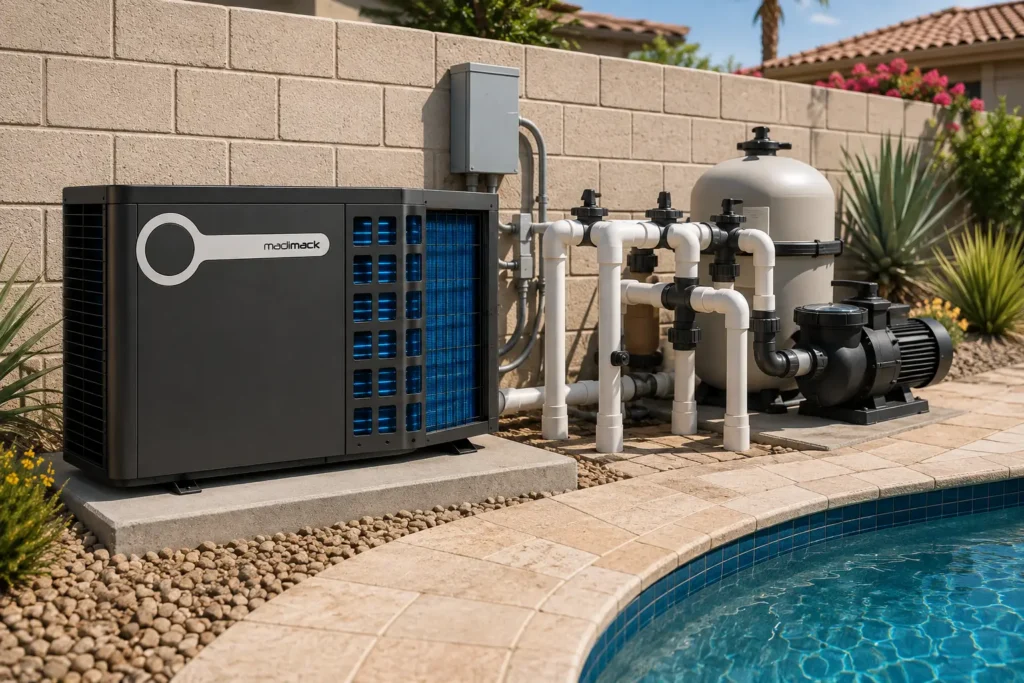
A professional Pool Heat Pump Installation involves integrating the new heat pump with your existing pool circulation system and electrical service. Every equipment pad is different, so the installation should be planned around the pool, existing equipment, available space, and electrical capacity.
What Is Included in a Pool Heat Pump Installation?
A typical installation may include:
- Equipment Placement — Positioning the heat pump where it has adequate airflow and appropriate service clearance.
- Plumbing Connections — Connecting the heat pump into the pool’s circulation system so filtered water flows through the heat exchanger before returning to the pool.
- Electrical Connection — Providing the properly sized dedicated electrical circuit, breaker, disconnect, and wiring required for the selected heat pump.
- Equipment Pad — Installing the heat pump on a stable, level equipment pad where required.
- System Configuration — Setting up heating and cooling operation and confirming proper water flow through the system.
- Startup & Testing — Operating the system after installation to verify water flow, temperature control, heating and cooling functions, and overall performance.
Proper installation is especially important with a full-inverter heat-and-cool system. Correct water flow, electrical supply, airflow, and equipment placement allow the heat pump to operate as designed and help provide reliable long-term performance.
Where Should a Pool Heat Pump Be Installed?
Proper placement is an important part of Pool Heat Pump Installation because a heat pump needs access to large volumes of outdoor air to operate efficiently. The equipment should be installed outdoors in a location that provides adequate airflow, proper clearances, and convenient access for future service.
The ideal location depends on the existing pool equipment, available space, electrical service, plumbing distance, drainage, and the manufacturer’s required clearances. A heat pump should not be placed in an enclosed area where discharged air can be pulled back into the unit and reduce performance.
For Arizona installations, we also consider intense summer sun, surrounding walls, landscaping, equipment-pad conditions, and the distance between the heat pump and the existing pool circulation system.
Pool Heat Pump Airflow and Clearance Requirements
Proper airflow is one of the most important considerations when installing a pool heat pump. The system draws large volumes of outdoor air through the evaporator coil, extracts available heat from that air, and then discharges the processed air away from the unit.
If airflow is restricted—or if discharged air is allowed to recirculate back into the heat pump—performance and efficiency can be reduced. This is why adequate clearance around and above the equipment is an important part of proper installation.
Each installation should follow the clearance requirements specified for the particular Madimack InverTITAN model. Nearby walls, fences, landscaping, roof overhangs, and other pool equipment should all be considered when selecting the final location.
Why Proper Airflow Matters
- Efficient Heat Transfer — Unrestricted airflow allows the heat pump to exchange heat with the surrounding air effectively.
- Better Heating & Cooling Performance — Proper airflow helps the system maintain consistent performance in both operating modes.
- Prevents Air Recirculation — Correct placement helps keep discharged air from being drawn back into the unit.
- Allows Service Access — Adequate space around the heat pump makes future inspection, maintenance, and service easier.
- Supports Long-Term Performance — Proper installation conditions help the equipment operate as designed throughout its service life.
Pool Heat Pump Plumbing and Water Flow
Proper plumbing and water flow are essential to a successful Pool Heat Pump Installation. The heat pump is connected to the pool’s circulation system so filtered pool water passes through the heat exchanger, where heat is either added to or removed from the water before it returns to the pool.
In a typical installation, the heat pump is installed after the pool filter so clean, filtered water enters the heat exchanger. The plumbing layout should provide the proper flow rate while minimizing unnecessary restrictions that could reduce circulation-system performance.
Correct pipe sizing, fittings, valve placement, and equipment configuration all contribute to proper water flow. Existing pumps, filters, sanitizing equipment, automation systems, and other equipment should be considered when planning the installation.
Why Proper Water Flow Matters
- Efficient Heat Transfer — Proper water flow allows the heat exchanger to transfer heat efficiently between the refrigerant system and pool water.
- Consistent Temperature Control — Adequate circulation helps distribute heated or cooled water evenly throughout the pool.
- Reliable Operation — Insufficient or excessive flow can affect heat pump performance and operation.
- System Compatibility — Plumbing should be designed to work properly with the existing pool pump, filter, sanitizer, and other equipment.
- Serviceability — Proper valve and plumbing placement can make future maintenance and equipment service easier.
Every Arizona pool equipment system is different. Before installation, the existing circulation system should be evaluated to determine the appropriate plumbing configuration and confirm that adequate water flow can be provided for the selected Madimack InverTITAN heat pump.
Electrical Requirements for a Pool Heat Pump
A pool heat pump requires a properly sized electrical supply to operate safely and reliably. Electrical requirements vary depending on the specific heat pump model, so the available electrical service should be evaluated before the equipment is selected and installed.
A professional Pool Heat Pump Installation may require a dedicated circuit, appropriately sized breaker, wiring, and an approved disconnect located near the heat pump. The existing electrical panel must also have sufficient capacity for the selected equipment.
For Arizona homeowners, evaluating electrical requirements early in the process is important because the distance between the main electrical panel and pool equipment can affect the installation. Longer electrical runs, existing panel capacity, and equipment-pad location should all be considered when planning the project.
Electrical Items We Evaluate
- Available Electrical Capacity — Determine whether the existing electrical service can support the selected heat pump.
- Dedicated Circuit — Confirm the appropriate dedicated electrical circuit for the equipment.
- Breaker Requirements — Match the circuit protection to the requirements of the specific heat pump model.
- Electrical Disconnect — Provide an appropriate disconnect near the equipment where required.
- Distance to the Equipment Pad — Evaluate the electrical run between the service panel and heat pump location.
- Existing Pool Equipment — Consider pumps, automation, sanitizing systems, and other electrical equipment already operating at the pool.
Electrical requirements should always be determined from the specifications of the selected heat pump and the conditions at the property. Evaluating these requirements before installation helps prevent surprises and allows the complete heat pump installation to be planned correctly.
Choosing the Right Size Pool Heat Pump for Your Arizona Pool
Proper sizing is one of the most important parts of a successful Pool Heat Pump Installation. A heat pump should be selected based on more than pool gallons alone. The pool’s surface area, desired water temperature, swimming season, sun exposure, wind conditions, pool features, and equipment configuration can all affect heating and cooling requirements.
Arizona pools present an additional challenge because the same system may be expected to heat the pool during cooler months and remove excess heat during the summer. Selecting the right capacity helps provide dependable temperature control while allowing the heat pump to operate efficiently.
Factors We Consider When Sizing a Heat Pump
- Pool Surface Area — Larger exposed water surfaces generally require greater heating and cooling capacity.
- Desired Water Temperature — The difference between outdoor conditions and your target pool temperature affects system requirements.
- Swimming Season — Heating during colder months may require more capacity than extending the season during spring and fall.
- Sun & Wind Exposure — Direct sunlight can add heat, while wind can increase evaporation and heat loss.
- Pool Covers — A properly used pool cover can significantly reduce overnight heat loss and evaporation.
- Water Features — Fountains, waterfalls, and other features can increase evaporation and affect heat loss.
- Heating & Cooling Goals — A system intended for both winter heating and summer cooling should be sized with both operating conditions in mind.
Madimack InverTITAN 90, 112 & 140
The Madimack InverTITAN lineup gives Arizona pool owners multiple capacity options for residential pool heating and cooling. Rather than selecting a model based only on pool size, we evaluate the individual pool and installation conditions to determine which system is the appropriate match.
Madimack InverTITAN 90 — Efficient heating and cooling for smaller residential pool applications.
Madimack InverTITAN 112 — Increased heating and cooling capacity for residential pools requiring additional performance.
Madimack InverTITAN 140 — Higher-capacity heating and cooling for larger residential pool applications and pools with greater temperature-control requirements.
What to Expect on Pool Heat Pump Installation Day
A professional installation should be organized around minimizing disruption to your existing pool system while making sure the new heat pump is properly integrated, configured, and tested.
While every Arizona installation is different, the process typically includes:
- Review the Installation Location — Confirm equipment placement, required clearances, plumbing route, electrical access, and serviceability.
- Prepare the Equipment Area — Position or install the equipment pad and prepare the location for the new heat pump.
- Complete the Plumbing — Integrate the heat pump into the existing pool circulation system using the appropriate plumbing and valves.
- Complete the Electrical Connection — Connect the heat pump to the properly sized electrical circuit and disconnect.
- Configure the Heat Pump — Set up the system for heating and cooling operation and verify the controls.
- Start and Test the System — Confirm proper water flow, check system operation, and verify that the heat pump responds correctly in the selected operating modes.
- Review Operation with the Homeowner — Explain basic temperature settings, heating and cooling modes, and normal system operation.
The amount of time required for installation depends on the existing equipment, plumbing and electrical requirements, equipment-pad conditions, and the complexity of the installation. Evaluating these conditions beforehand allows the project to be planned properly and helps avoid unnecessary surprises.
How Long Does Pool Heat Pump Installation Take?
The time required for a Pool Heat Pump Installation depends on the existing pool equipment, electrical service, plumbing configuration, equipment location, and the amount of preparation required before the new system can be installed.
A straightforward installation with adequate electrical capacity and convenient access to the existing pool plumbing can generally be completed more efficiently than a project requiring electrical upgrades, longer plumbing or electrical runs, equipment-pad modifications, or relocation of existing equipment.
Rather than setting the same installation expectation for every pool, we evaluate the property beforehand so the equipment location, plumbing, electrical requirements, and installation conditions can be identified before work begins.
What Can Affect Installation Time?
- Electrical Requirements — Panel capacity and the distance to the equipment pad can affect the scope of work.
- Plumbing Configuration — Existing equipment layout and the location of the heat pump determine the plumbing required.
- Equipment Pad — Additional preparation may be necessary if there isn’t an appropriate location for the heat pump.
- Installation Distance — Longer plumbing and electrical runs can require additional installation time.
- Existing Pool Equipment — Pumps, filters, automation, sanitizers, and other equipment may affect the final configuration.
- Site Access — Access to the pool equipment area can influence equipment placement and installation.
Our goal is to identify these conditions before installation so the project can be planned properly and the new Madimack InverTITAN system can be installed correctly from the beginning.
Why Professional Pool Heat Pump Installation Matters
A quality heat pump is only one part of a successful pool heating and cooling system. Proper Pool Heat Pump Installation helps ensure the equipment has the airflow, water flow, electrical supply, plumbing configuration, and operating conditions needed to perform as designed.
Even a properly sized heat pump can underperform if it is installed with restricted airflow, inadequate water flow, incorrect plumbing, insufficient electrical capacity, or poor equipment placement. Planning these details before installation helps protect the performance of the entire system.
For Arizona pool owners, professional installation is especially important because the equipment may operate under demanding conditions throughout the year—from heating pool water during cooler winter temperatures to removing excess heat during the hottest summer months.
A Complete Installation Approach
- Proper Equipment Sizing — Match the heat pump to the individual pool and the homeowner’s heating and cooling goals.
- Correct Equipment Placement — Provide appropriate airflow, clearances, drainage, and service access.
- Proper Plumbing & Water Flow — Integrate the heat pump correctly with the existing pool circulation system.
- Correct Electrical Requirements — Make sure the selected equipment has the appropriate electrical supply and protection.
- System Setup & Testing — Confirm proper operation after the installation is completed.
- Homeowner Orientation — Help the homeowner understand basic operation, temperature settings, and heating and cooling modes.
The goal isn’t simply to install a heat pump. It’s to create a complete heating and cooling system that works with your existing pool equipment and provides dependable temperature control for the way you want to use your pool.
Find the Right Pool Heat Pump Installation for Your Arizona Pool
Every Arizona pool and equipment system is different. Pool size, surface area, desired water temperature, swimming season, existing equipment, electrical capacity, plumbing layout, and available installation space can all influence the right heat pump and installation approach.
We’ll evaluate your pool, equipment, and heating and cooling goals to help determine which Madimack InverTITAN system is best suited for your needs and how it should be installed.
Start With a FREE Pool Heat Pump Evaluation
Before recommending equipment, we’ll look at the conditions that actually affect performance and installation. This helps us properly plan the system rather than simply choosing a heat pump based on pool size alone.
Get a FREE Pool Heat Pump Evaluation