
Keep Your Arizona Pool Comfortable During the Hottest Summer Months
Pool Cooling in Arizona can make a major difference when summer temperatures push swimming pool water beyond a comfortable level. During prolonged Arizona heat, pool water can become surprisingly warm—especially in pools with significant sun exposure.
A properly sized heat-and-cool pool heat pump can reverse the normal heating process and remove excess heat from the pool water. This helps maintain a more comfortable swimming temperature during Arizona’s hottest months while giving you heating capability when cooler weather returns.
Instead of installing separate systems for heating and cooling, Arizona pool owners can use one heat-and-cool system to help manage water temperature throughout more of the year.
Why Arizona Swimming Pools Get Too Hot
Arizona swimming pools can absorb a tremendous amount of heat during the summer. Long days of intense sunshine, high daytime temperatures, warm nights, and surrounding hardscape can gradually push pool water temperatures well beyond what many swimmers find refreshing. Pool Cooling in Arizona becomes especially valuable during these extended periods of intense summer heat.
Pools with significant direct sun exposure are especially susceptible. Decking, block walls, landscaping materials, and other surfaces surrounding the pool can also absorb heat throughout the day and contribute to the warm environment around the water.
As water temperatures continue to rise, the pool may offer less relief from Arizona’s summer heat. That’s where an actively cooled pool can make a noticeable difference in swimming comfort.
- Direct Sun Exposure — Arizona’s intense sunshine continuously adds heat to the pool during the day.
- High Air Temperatures — Extended periods of 100°F+ weather can make it difficult for pool water to cool naturally.
- Warm Overnight Temperatures — Hot summer nights can limit the amount of heat a pool releases after sunset.
- Pool Surface Area — Larger exposed water surfaces can absorb significant solar energy.
- Surrounding Hardscape — Decks, walls, and masonry can absorb and radiate heat around the pool.
How a Pool Heat Pump Cools Your Pool
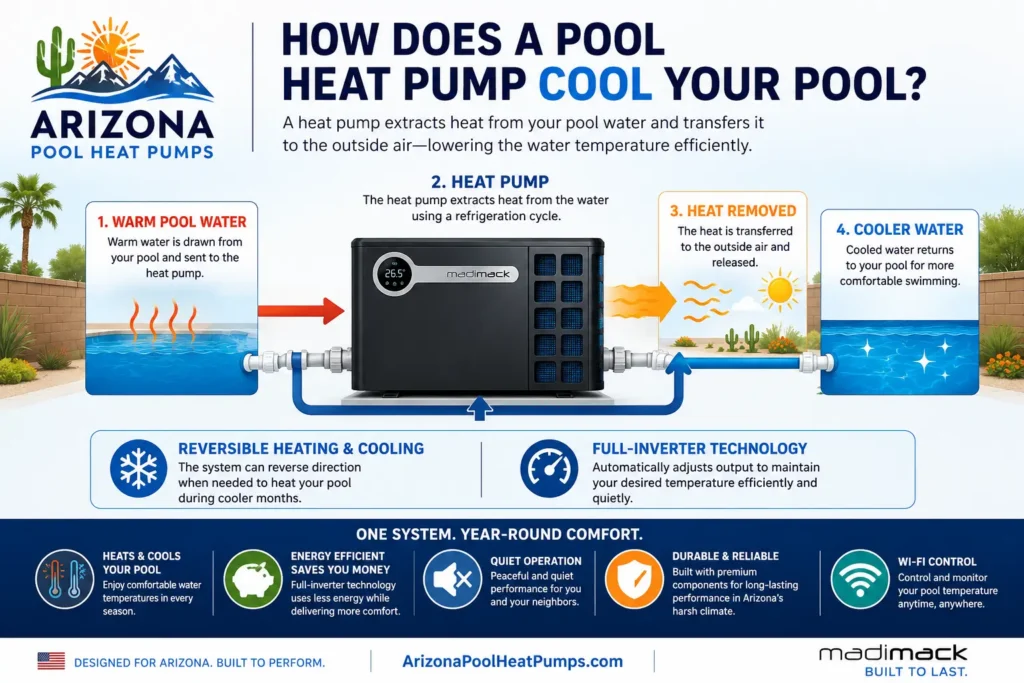
A heat-and-cool pool heat pump can operate in reverse to remove unwanted heat from your swimming pool. Instead of transferring heat from the surrounding air into the water, the system extracts heat from the pool water and releases it into the outside air.
Pool water circulates through the heat pump, where heat is transferred away from the water through the refrigeration cycle. The cooled water then returns to the pool, gradually lowering the overall water temperature until the desired setting is reached.
Once the pool reaches the selected temperature, a full-inverter system can adjust its operating output to help maintain comfortable water conditions efficiently rather than simply operating at full power whenever cooling is required.
Benefits of Cooling Your Pool with a Heat Pump
Pool Cooling in Arizona with a heat-and-cool pool heat pump provides several advantages for homeowners who want more comfortable water temperatures during the hottest months of the year. For many homeowners, Pool Cooling in Arizona provides a practical way to maintain more comfortable water temperatures throughout the summer.
- More Comfortable Summer Swimming — Lower excessively warm pool water to a more refreshing temperature during Arizona’s hottest months.
- Heating and Cooling in One System — Warm your pool during cooler weather and cool it when summer temperatures push the water too high.
- Automatic Temperature Control — Set your desired water temperature and allow the system to help maintain more consistent conditions.
- Full-Inverter Efficiency — Variable-speed operation adjusts output according to demand rather than simply operating at full capacity.
- Quiet Operation — Full-inverter technology provides quieter operation while maintaining comfortable pool temperatures.
- Extend Your Comfortable Swimming Season — Heating and cooling capability gives you greater control over pool comfort throughout more of the year.
Why Heat-and-Cool Technology Makes Sense in Arizona
Arizona presents an unusual challenge for swimming pool owners. During cooler fall, winter, and spring weather, pool water may be too cold for comfortable swimming. During the peak of summer, that same pool can become warmer than many swimmers find refreshing.
A heat-and-cool pool heat pump addresses both conditions with one system. In heating mode, the unit transfers available heat from the surrounding air into the pool water. In cooling mode, the process reverses, removing excess heat from the pool and releasing it into the outside air.
This versatility is particularly useful in Arizona because your desired water temperature doesn’t change simply because the weather does. A properly sized heat-and-cool system gives you greater control over pool temperature through changing seasons.
Instead of letting Arizona’s weather determine when your pool is comfortable, a heat-and-cool system gives you greater control over when and how you enjoy it.
Choose the Right Madimack InverTITAN for Your Pool
Every Arizona pool is different, and selecting the right heat-and-cool system depends on more than pool size alone. Pool surface area, sun exposure, desired water temperature, surrounding conditions, swimming season, and equipment configuration can all affect cooling requirements. The Madimack InverTITAN lineup gives us three options for properly matching the system to your pool.
Madimack InverTITAN 90
Efficient heating and cooling for smaller residential pool applications. The InverTITAN 90 provides full-inverter operation with the ability to cool excessively warm pool water during Arizona’s summer while providing heating when cooler weather arrives.
Madimack InverTITAN 112
A step up in heating and cooling capacity for residential pools. The InverTITAN 112 provides additional capacity while maintaining quiet, energy-efficient full-inverter operation and precise temperature control.
Madimack InverTITAN 140
Higher-capacity heating and cooling for larger residential pool applications. The InverTITAN 140 provides the greatest heating and cooling capacity in the three-model lineup for pools requiring additional performance.
What Affects Pool Cooling Performance in Arizona?
Pool Cooling in Arizona depends on the individual pool and its surrounding environment. Just as proper sizing matters for heating, several factors determine how effectively a heat pump can remove excess heat and maintain a comfortable water temperature.
- Pool Surface Area — Larger exposed water surfaces receive more solar energy and can require additional cooling capacity.
- Desired Water Temperature — Cooling a very warm pool a few degrees requires less capacity and operating time than maintaining a substantially lower temperature.
- Direct Sun Exposure — Pools receiving full Arizona sunshine throughout the day can continuously gain heat while the cooling system is operating.
- Outdoor Air Temperature — Extreme daytime and nighttime temperatures influence how quickly the pool gains and releases heat.
- Pool Covers — Covers can reduce evaporation but may also trap heat, which is important to consider when cooling a pool.
- Wind & Evaporation — Air movement and evaporation can naturally remove some heat from the water and affect cooling requirements.
- Swimming Season — How often and when you use the pool helps determine the temperature control strategy that makes the most sense.
- Pool Features — Waterfalls, spillways, fountains, and other water features can increase evaporation and influence water temperature.
That’s why we recommend evaluating the individual pool and how the homeowner wants to use it before selecting an InverTITAN model. Proper sizing helps the system provide effective cooling while maintaining efficient and consistent pool temperatures.
How Long Does It Take to Cool a Pool in Arizona?
There isn’t one cooling time that applies to every Arizona swimming pool. How quickly a pool cools depends on the starting water temperature, desired temperature, pool surface area, heat pump capacity, direct sun exposure, outdoor air temperature, wind, and other site conditions.
Pool cooling is generally a gradual process. Rather than waiting until the pool becomes excessively warm, a properly sized heat-and-cool system can be used to bring the water toward the desired temperature and then help maintain that temperature as Arizona’s summer conditions change.
Pools exposed to intense afternoon sun or very warm nighttime temperatures may continuously gain heat while the system is cooling. This is one reason proper equipment sizing and realistic temperature expectations are important when designing a pool-cooling solution.
Proper sizing matters. The goal isn’t simply to make the water colder—it’s to provide enough cooling capacity to maintain a comfortable swimming temperature under the conditions your particular pool experiences.
Pool Heat Pump Cooling vs. Other Pool-Cooling Methods
Arizona pool owners have several ways to reduce excessively warm water temperatures, but the methods differ considerably in how much control they provide. Some approaches rely primarily on evaporation, while an active heat-and-cool pool heat pump removes heat from the water to help maintain a selected temperature.
- Heat-and-Cool Pool Heat Pump — Actively removes heat from the pool water and provides thermostatic temperature control. The same system can also heat the pool during cooler weather.
- Water Features & Fountains — Moving water through the air can increase evaporation and provide some natural cooling, particularly when operated during cooler nighttime conditions.
- Pool Aerators — Spray water into the air to encourage evaporative cooling. Results depend heavily on weather conditions and evaporation rates.
- Nighttime Circulation — Running circulation during cooler nighttime hours may help the pool release some accumulated heat naturally, but it does not provide the same temperature control as active cooling.
- Shade — Reducing direct solar exposure can help limit daytime heat gain, although it does not actively remove heat already stored in the pool water.
For homeowners who simply want to reduce occasional summer heat, passive cooling methods may provide some benefit. For those who want more predictable temperature control—and the ability to both heat and cool the pool—a properly sized heat-and-cool pool heat pump provides a more complete year-round solution. For additional information about energy-efficient swimming pool heating and heat pump technology, visit the U.S. Department of Energy.
Heating and Cooling from One System
Arizona pool owners face two very different temperature challenges throughout the year. Pool water can become too cool for comfortable swimming during fall, winter, and spring, while prolonged summer heat can push water temperatures higher than many swimmers find refreshing.
A Madimack InverTITAN heat-and-cool pool heat pump addresses both conditions with one system. When heating is needed, the system transfers available heat from the surrounding air into the pool water. When cooling is needed, the refrigeration cycle reverses and removes excess heat from the water.
Full-inverter technology allows the system to adjust its operating output as conditions change rather than relying only on full-power operation. This provides greater control over pool temperature while supporting efficient, quiet operation.
One system. Heating when you need it. Cooling when you want it. More comfortable pool water throughout the Arizona swimming season.
Find the Right Pool Heating & Cooling Solution for Your Arizona Pool
Pool Cooling in Arizona starts with understanding how your pool behaves during the hottest months. Pool size, surface area, sun exposure, desired water temperature, pool covers, water features, and equipment setup can all affect cooling performance. Pool Cooling in Arizona is especially important for homeowners who want comfortable water temperatures during the hottest months of the year.
We’ll evaluate your pool and how you want to use it, then help determine which Madimack InverTITAN heat-and-cool system is best suited for your needs.
Get a FREE Pool Heat Pump Evaluation