
Extend Your Arizona Swimming Season with Efficient Pool Heating
Pool Heating in Arizona can make a big difference when cooler weather arrives. While Arizona may be known for warm weather, pool water can become surprisingly cool during fall, winter, and spring. A properly sized pool heat pump can extend your swimming season by efficiently maintaining a more comfortable water temperature when the weather begins to cool.
Unlike traditional pool heaters that create heat by burning fuel, a pool heat pump captures heat from the surrounding air and transfers it into your pool water. Arizona’s climate makes this technology especially well suited for homeowners who want dependable, energy-efficient pool heating.
How Pool Heat Pumps Heat Your Pool
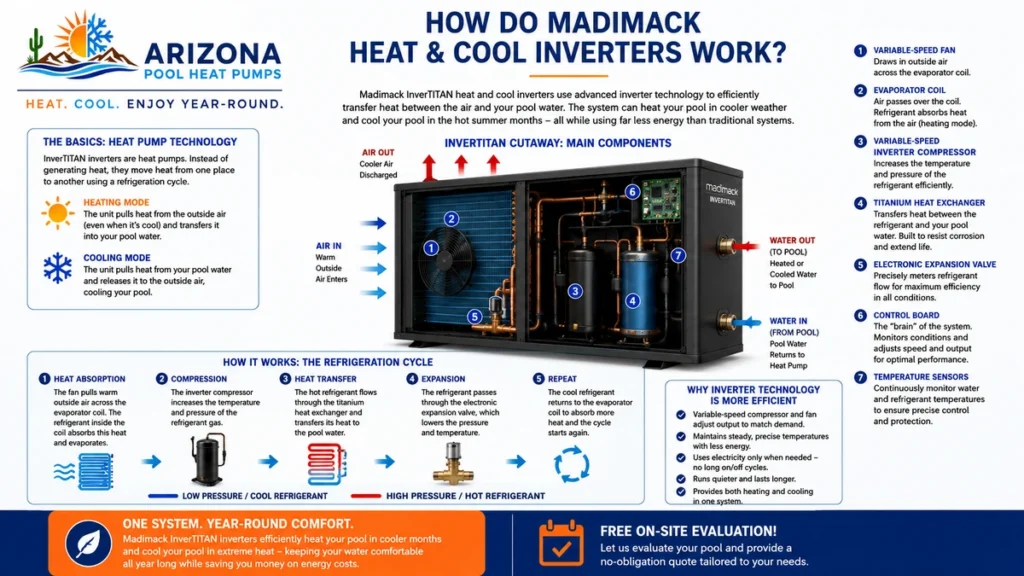
A pool heat pump works by drawing warm outside air across an evaporator coil. Refrigerant inside the system absorbs that heat, the compressor increases its temperature, and the heat is transferred through a heat exchanger into the circulating pool water. The heated water then returns to the pool.
Because a heat pump moves existing heat rather than creating heat through combustion, it can provide an efficient way to maintain comfortable pool temperatures during Arizona’s cooler swimming months.
Why Heat Pumps Work So Well in Arizona
Pool Heating in Arizona works especially well with heat pump technology because Arizona’s warm, dry climate creates excellent conditions for efficient operation.
This makes heat pumps especially well suited for extending the swimming season during Arizona’s fall, winter, and spring months. During warmer weather, a heat-and-cool system can also reverse the process and remove excess heat from the pool, helping maintain a more comfortable water temperature during the hottest part of the summer.
Benefits of Heating Your Pool with a Heat Pump
Pool Heating in Arizona with a heat pump offers several advantages for homeowners who want a longer, more comfortable swimming season.
- Extend Your Swimming Season — Enjoy comfortable pool temperatures during Arizona’s cooler fall, winter, and spring months.
- Energy-Efficient Heating — Heat pumps transfer existing heat from the surrounding air instead of creating heat through combustion.
- Consistent Water Temperature — Maintain a more comfortable and predictable pool temperature as outdoor conditions change.
- Heating and Cooling in One System — A heat-and-cool pool heat pump can warm your water during cooler months and cool it during Arizona’s extreme summer heat.
- No Natural Gas Required — An all-electric heat pump eliminates the need for a gas-fired pool heater.
- Ideal for Arizona’s Climate — Arizona’s generally warm ambient temperatures provide favorable conditions for efficient heat-pump operation.
Choose the Right Madimack InverTITAN for Your Pool
Every Arizona pool is different, and choosing the right heat pump depends on more than pool size alone. Desired water temperature, swimming season, sun exposure, wind, pool covers, and installation conditions can all affect heating requirements. The Madimack InverTITAN lineup gives us three options to properly match the system to your pool.
Madimack InverTITAN 90
Efficient heating and cooling for smaller residential pool applications. The InverTITAN 90 combines full-inverter operation, quiet performance, Wi-Fi control, and year-round heating and cooling capability.
Madimack InverTITAN 112
A step up in heating and cooling capacity for residential pools. The InverTITAN 112 provides additional capacity while maintaining the quiet, energy-efficient full-inverter operation of the InverTITAN lineup.
Madimack InverTITAN 140
Higher-capacity heating and cooling for larger residential pool applications. The InverTITAN 140 provides the greatest heating and cooling capacity in our three-model lineup for pools requiring additional performance.
What Affects Pool Heating Performance in Arizona?
Pool Heating in Arizona depends on proper pool heat pump sizing because every pool and backyard environment is different. Heating performance depends on several factors beyond the number of gallons in the pool… Understanding these conditions helps determine which heat pump will provide the comfort and performance you expect.
- Pool Surface Area — Larger water surfaces lose more heat to the surrounding air, especially overnight.
- Desired Water Temperature — Maintaining 84°F requires different heating performance than maintaining 78°F or 80°F.
- Outdoor Air Temperature — Heat pumps draw heat from the surrounding air, so changing weather conditions affect available heating capacity.
- Sun Exposure — Pools receiving direct Arizona sunshine can gain substantial natural heat during the day.
- Wind Exposure — Wind increases evaporation and heat loss from the pool surface.
- Pool Covers — A properly used pool cover can significantly reduce overnight evaporation and heat loss.
- Swimming Season — Heating primarily in spring and fall is different from trying to maintain comfortable water temperatures through the coldest part of winter.
- Pool Features — Waterfalls, spillways, fountains, and other moving-water features can increase evaporation and heat loss.
That’s why we recommend evaluating the individual pool and how the homeowner wants to use it before selecting an InverTITAN model. Proper sizing helps the system operate efficiently while providing more consistent pool temperatures.
How Long Does It Take to Heat a Pool in Arizona?
Pool Heating in Arizona is not instant, and heating time varies from one pool to another. How quickly a pool warms depends on the starting water temperature, desired temperature, outdoor air temperature, pool surface area, heat pump capacity, wind conditions, sun exposure, and whether a pool cover is being used.
Pool heat pumps are generally designed to raise the water temperature gradually and then efficiently maintain the desired temperature. Rather than waiting until the day you want to swim to begin heating the pool, many homeowners achieve better results by allowing the heat pump to bring the pool to the desired temperature and then maintain it as conditions change.
Proper sizing matters. A correctly sized heat pump can provide better heating performance and temperature recovery while avoiding unrealistic expectations about how quickly a large body of water can be heated.
Pool Heat Pump vs. Gas Pool Heater in Arizona
Both heat pumps and gas heaters can warm a swimming pool, but they operate very differently. A gas heater creates heat by burning fuel and can raise water temperature quickly. A pool heat pump uses electricity to capture heat from the surrounding air and transfer it into the pool water, making it particularly well suited for maintaining comfortable temperatures over longer periods.
For many Arizona homeowners who want to extend their swimming season and maintain a consistent pool temperature, a heat pump can provide an efficient alternative to traditional gas heating. Arizona’s generally mild climate also gives heat pumps access to usable heat in the surrounding air through much of the year.
- Heat Pump: Best suited for efficient, steady temperature maintenance and extended swimming seasons.
- Gas Heater: Provides rapid heating when fast temperature increases are the priority.
- Heat Pump: All-electric operation with no natural gas combustion.
- Gas Heater: Requires a gas supply and burns fuel whenever heating.
- Heat & Cool Heat Pump: Can both warm and cool the pool from one system.
- Gas Heater: Primarily provides heating rather than active pool cooling.
The best choice depends on how you use your pool, how quickly you want it heated, your desired swimming season, and your existing equipment. For Arizona homeowners interested in both heating and summer cooling, a heat-and-cool pool heat pump offers an advantage that a traditional gas heater cannot provide by itself.
For additional information about energy-efficient swimming pool heating, visit the U.S. Department of Energy’s guidance on pool heating.
Find the Right Pool Heating Solution for Your Arizona Pool
Pool Heating in Arizona starts with understanding that every pool is different. Pool size, surface area, desired water temperature, swimming season, sun exposure, wind, pool features, and existing equipment all play a role in determining the right heating solution.
We’ll evaluate your pool and how you want to use it, then help determine which Madimack InverTITAN heat-and-cool system is best suited for your needs.
Get a FREE Pool Heat Pump Evaluation